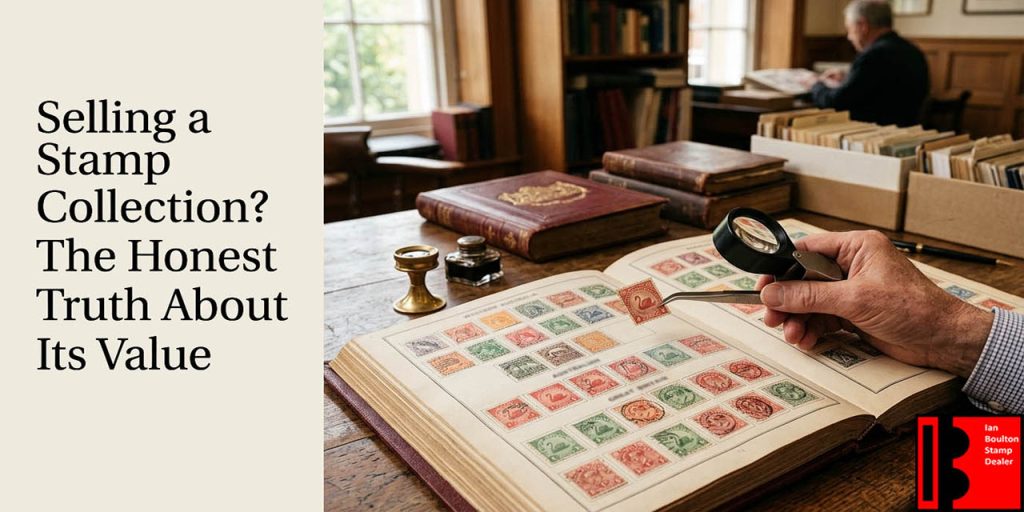
Selling a Stamp Collection in 2026?

With over four decades of experience dealing in stamps, postal history, and all philatelic-related products, I have developed a clear, defined, and professional process for appraising and purchasing both single stamps and collections. Are you looking at selling a stamp collection? My goal is simple: to ensure you are treated fairly and and professionally and receive an accurate valuation.
Most enquiries I receive are from individuals who have discovered a stamp collection during a clean-up or have been given it either recently or when they were a child, by a family relative.
The truth is, very few of these collections are worth more than a few dollars—sometimes even less than the value of the physical albums containing them!
The Core Myth of Stamp Value
Most non-collectors (and quite a few amateur collectors) believe that the age of a stamp equals rarity, and that high quantity automatically adds up to great riches. The hard fact is scarcity is what creates rarity, and only quality can lead to that fortune.
1. Understanding Early Postage Over-Supply
When it comes to historic stamps, it is frequently overlooked that many early postage stamps were issued over a long period of time. Consequently, there were literally millions produced for all forms of early communication, remembering there were no emails or mobile phones!
Hence, the numerous ½d or 1d values that are often found in these early collections represented the basic postal rate for most messages. Whether it was a one-line postcard, a full-page letter, an advertising notice, or a financial transaction (no internet banking back then!), these stamps formed the basis of these old collections, and they are often in very poor condition.
2. What a Serious Collection Actually Looks Like
The fortunate people are those given or who inherit collections that have been carefully and carefully assembled by a serious collector. This was someone who studied their collecting field, frequently purchased from stamp dealers and auction houses, and spent a lot of money in the process.
This intentional study is reflected in quality examples, often in complete sets to the top value (such as $20, 20/-, or £2), and presented neatly in quality albums. They usually also centre around only one or two countries or focus strictly on a particular reign.
However, this is the rare exception. Most everyday collections were obtained from everyday mail, cheap packets from a newsagent, or by swapping stamps with people of a similar collecting mindset.
The Perils of Online Comparisons
The early collector rarely invested in literature to study the hobby and thus missed changes in watermarks, printings or perforations. Many non-collectors frequently visit auction sites like eBay to make comparisons with stamps that are priced highly because of such specialist varieties. They then ring me to tell how they have the exact stamp and it is my lucky day to be offered such an item, in fact they have 50 of them! In addition, these collectors rarely bought mint stamps and relied entirely on used stamps, so the odd specialist item is often of poor quality.
3. The “Schoolchild” General World Albums
Back in the day, global packets of stamps were bought to fill numerous gaps in an album devoted to every country in the world, a feat that even back then was nigh impossible.
These are commonly referred to as “schoolboy” collections (but let’s add “schoolgirl” to be inclusive!). Typically, a single page was given over to popular countries, while up to ten lesser-known countries were squeezed together into the last few pages.
It is best to work on the assumption that collections housed in such albums are of little value. After 40 years in the industry, having valued literally thousands of such collections, the number of times a gem has been found is very few.
4. The Quick Triage Check
Buying a catalogue without a keen knowledge of stamps is a waste of time and money. I have seen catalogue values running into thousands of dollars but frequently the wrong stamps have been identified, and the condition has not been considered. Remember, the catalogue price is the “selling” price by a full-time dealer often in a large capital city such as London with massive overheads and numerous staff so your dealer in Perth is not going to be selling at those prices, let alone buying at those prices!
If I do end up viewing your collection, please do not be surprised by a quick glance through such albums to first reveal the type of collection. This is often determined by the quality of the album before I even open the first page.
“No serious collector is going to store their quality purchases costing hundreds of dollars in a cheap, Chinese-made stockbook they bought from Coles for $5!”
If the album contains a generic cross-section of used stamps from many different countries with no regard for sets, mixing mint and used together alongside damaged examples, it is almost certainly of minimal commercial value. Our only hope is that the collector accidently acquired a stamp of some rarity but as I say this is highly unlikely. Quality always comes into the equation, even with so called rare stamps. Torn or damaged stamps, whether mint or used, are usually verging on worthless. Likewise, stamps that have stains or have brown spots or mint without gum all fall into the same category.
5. Modern Australia Post Issues (1970s – 1990s)
Another incredibly popular way of collecting was purchasing mint stamps directly from Australia Post. It was common in the 1970s to 1990s to purchase mint sets in blocks and sometimes even sheets, often with the accompanying First Day Covers (FDCs).
These are now worth a small fraction of their original face value due to massive oversupply.
Dealers buy these at a percentage of this face value, in our case we pay 20c in the dollar, that is 20% of the total face value. This only applies to mint, unused stamps, which can be in presentation packs or the annual year books however it does not apply to FDC’s.
It is always worth considering if you can use them for postage yourself, in which case you are receiving the total 100% of their monetary value. Mint Australian issues are now pouring onto the market and there are few collectors of this material to absorb them.
6. Our Valuation Principle
I always provide what is known as a “buying” valuation. This is the highest price I am willing to pay there and then to purchase the collection outright.
Never will I “cherry pick” from collections to simply remove the best items. This is poor service and simply renders your remaining collection worthless. Instead, I will make an “offer to buy” everything. You can then choose a charity for the remaining material to benefit from following the process. You can decide which charity can benefit such as Working Paws Australia, Kaarakin Black Cockatoo Conservation Centre or the Cancer Council Western Australia.
I rarely charge for an appraisal unless it is a formal written evaluation required for insurance or probate courts. I prefer to educate the seller as much as possible as to what they have and the options available for its sale if this is a route they wish to pursue, however I would always prefer you took up this amazing hobby!
With 10 to 20 calls a day, yes, a day, it is clear to say nearly every home in WA has a stamp collection or “hoard” and these were accumulated when people were time rich and cash poor, plus nothing was thrown away. Please remember, times were very different when the majority of these stamps were saved by the household!
Finally, if you do have stamps that do not have a secondary market value, please consider “recycling” them. Offer them free of charge to any collectors you know, or deposit them at a charity shop where they can be sold to spark the curiosity of a new hobbyist. Hopefully, they will end up in the hands of a collector who can get further enjoyment from them!
Ready to get an honest assessment?
Whether you want to drop into an upcoming Perth valuation clinic or coordinate a private home visit for a large specialist estate, Ian is here to help.
Contact Ian Boulton Today