
The Great Britain 1840 Penny Black

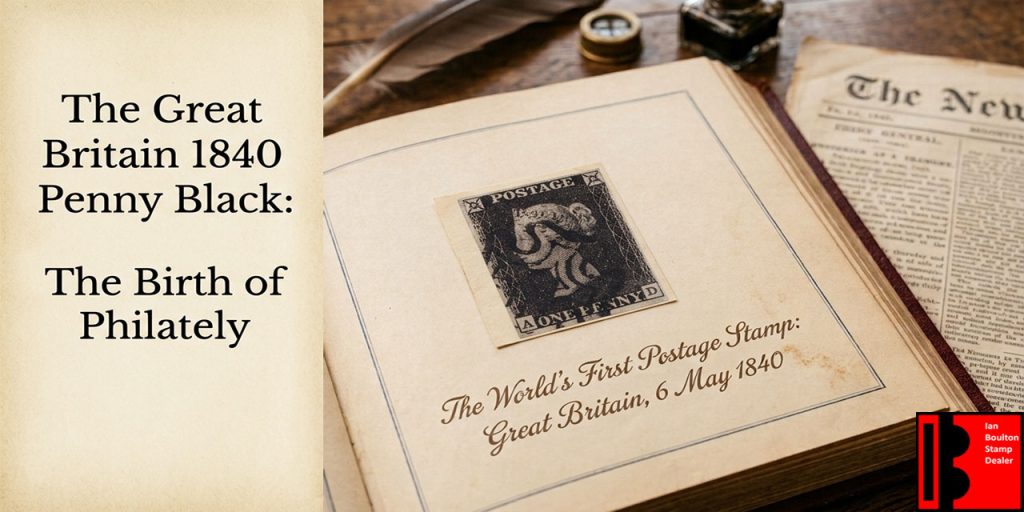
The world’s first official adhesive postage stamp was issued by Great Britain on 6th May 1840. The 1840 Penny Black remains today the World’s most famous stamp but not the rarest as often thought.
If you have ever wondered about the history of this legendary issue, or if you are looking to understand the value of an example in your possession, this guide breaks down the true story of how postal reform changed global communication forever.
The Birth of Postal Reform
The history of the 1840 Penny Black dates back to February 1837, when teacher and inventor Rowland Hill published a groundbreaking pamphlet entitled “Post Office Reform: Its Importance and Practicability”.
In this paper he illustrated the fact that the cost of conveyance of a letter was very little compared to the cost of its collection and delivery and thus it would be quite fair to all parties to charge a uniform rate of postage irrespective of distance.
His views created a great amount of public interest and as a result, a Committee of the House of Commons was appointed to enquire into the rates and practicalities of charging postage. The Committee reported in favour of Hill’s proposals and a Bill was introduced which received the Royal Assent on 17th August 1839.
The 1d Uniform Rate
The Lords of the Treasury were asked to regulate and supervise the operation, that was the postage of letters could be prepared by means of “labels”. They ordered the labels to be prepared as quickly as possible, meanwhile it was decided from and after the 10th of January 1840 to introduce a uniform rate of postage for all letters transmitted by post between places within the United Kingdom. It was to be without reference to the distance conveyed and the cost – 1d. in the case of letters not exceeding ½ oz.
Designing the Sovereign’s Profile
Suggestions for the design of the first stamp were invited from artists, men of science and the general public. Hill was highly determined to see a portrait of Queen Victoria appear on the stamp and Benjamin Cheverton submitted such sketches.
It was finally left for William Wyon, an expert engraver and Chief Engraver of Seals to the Queen, to prepare the design – the Wyon head. The design was based on a medal originally produced to mark Queen Victoria’s visit to the City of London in 1837.
Plates, Security, and Sheet Layout
The prestigious security printing firm Messrs. Perkins, Bacon and Petch of Fleet Street was awarded the contract to manufacture the printing plates.
To deter forgeries, Hill requested an array of complex security features were executed with master banknote craftsmanship:
- Corner Letter Combinations: Each sheet of 240 stamps was laid out in 20 horizontal rows of 12. Each stamp featured a unique combination of letters in its lower corners. The top-left stamp was lettered
AA, progressing systematically row-by-row down to the bottom-right stamp atTL. This allowed postmasters to spot sheets printed from forged plates. - Engine-Turned Background: A complex, geometric background pattern produced using specialized engraving lathes.
- The Crown Watermark: An additional safeguard was the “Crown” watermark in the handmade paper.
The “Imperforate” Reality: What Dictates Value Today?
Another defining feature of the 1840 Penny Black is that it was issued imperforate. Stamp perforating machines were not introduced until more than a decade later. This meant that every single stamp had to be individually cut from the printed sheet using scissors, a desk knife, or in many hasty cases, simply torn apart.
Today a major factor in the pricing of this stamp are its margins and how big they are. The bigger and more even the margins, the more valuable the stamp. In addition to this is the clarity, colour, and type of cancel used of them.
Another factor is the plate number. Eleven different plates were used however plate one was later given two numbers 1a and 1b after substantial wear meant it had to be repaired. The Penny Black did not incorporate the plate number in its design, unlike other issues, and therefore only by studying identifiable blocks which contain the plate number in the sheet margin or minor variations in the design, coupled with the position of the corner letters, can they be traced to a particular plate. All these factors determine the price of a Penny Black.
Did You Know?
“One of the most famous quirks of Great Britain’s postage stamps, which continues to this day, is the complete omission of the country’s name on the design. At the time it wasn’t really required as Great Britain was the only stamp issuing country in 1840 and they were in effect only ‘locals’.”
The Myth of Rarity
While the 1840 Penny Black is undeniably famous, the widespread belief that it is an extremely rare stamp is a complete myth.
To keep pace with the massive public demand for the uniform penny post, the printers worked at a rapid pace. On average, they produced over six million stamps every single month. In total, approximately 68 to 70 million Penny Blacks were printed during its brief one-year run before it was replaced by the Penny Red in 1841.
Amusingly, the cost to the British Government to produce these stamps was just 6d per thousand!
The Launch and Legacy
The stamps were originally intended to go on sale nationwide on 1st May 1840. However, due to logistical delays in distributing adequate stock to remote regional post offices, the official launch was delayed until 6th May 1840.
Note: A small handful of historic “early-use” envelopes do exist postmarked 2nd May 1840 carrying Penny Blacks, which are highly sought-after treasures of postal history.
The new pre-payment labels were an instant, resounding success. The public quickly embraced the ease of the penny post, setting off a global communication revolution. Today, the basic system of prepaying for mail delivery remains the foundation of postal services in every country around the world.
Get a Professional, Direct Assessment
If you have inherited an early Great Britain collection or have come across a Penny Black and want to determine its exact plate variety and margin value, contact Ian Boulton Stamp Dealer today.
Enquire About a Stamp Valuation